W·A·R·P — Wibey Autonomous Release Pipeline
Overview
WARP is a fully autonomous, end-to-end SDLC workflow that ingests requirements from a JIRA ticket
and proceeds through implementation, code review, testing, CI/CD monitoring, and
non-production deployment, culminating with a production ready git pull request ready for review — all driven by WIBEY.
WARP unifies the entire SDLC workflow inside WIBEY, eliminating the friction of juggling JIRA, GitHub, kitt,
Concord, Looper, Gatekeeper, Slack, and the countless other systems used in Walmart software deployment. A
single command — /warp TICKET-ID — builds, tests and preps a feature, end to end.
Pipeline Phases
WARP executes four sequential phases, each chaining automatically on success:
›
Phase 0
🔍
Prechecks
- PR detection & state
- GitHub CLI + branch auth
- Concord + OAuth tokens
- Snyk + contract binary
- Clean working tree
›
Phase 1
🧩
Requirements & Implementation
- Fetch JIRA requirements
- Analyze codebase + branch diff
- Generate implementation plan
- Autonomously write feature code
›
Phase 2
🧪
Testing & Quality Gates
- Auto-generate test code
- Self-heal failures
- Commit updates
static unit component
coverage integration
contract e2e
›
Phase 3
🚀
Deployment
- Create PR → Kitt CI/CD
- Qodo AI code review
- Monitor Concord/Looper
- Self-heal CI failures
- Notify via email, Slack & JIRA
›
🤖 Fully Autonomous — No Human Intervention Required
- Phase 0 — Prechecks: Pre-flight validation checks covering git state,
authentication (JIRA, Concord, Akeyless), branch readiness, and environment configuration.
Runs first regardless of which phase is requested.
- Phase 1 — Implementation: Fetches JIRA ticket requirements (summary,
description, acceptance criteria, subtasks), analyzes the codebase, generates an implementation
plan, and autonomously implements the feature.
- Phase 2 — Testing: Executes testing gates for all categories of quality
validation — static tests for security and formatting, unit tests, diff coverage, component
tests, Snyk security scanning, contract, integration and end-to-end testing. WARP testing is
self-healing with up to 9 fix attempts per test gate.
- Phase 3 — Deployment: Creates PR, runs Qodo AI code review (auto-addressing
suggestions), monitors CI/CD pipelines (Concord/Looper), self-heals CI failures, and sends
Slack, JIRA and email notifications on completion.
Multi-Agent Architecture
WARP uses a tiered multi-agent strategy that matches model capability to task complexity,
balancing cost, speed, and reasoning depth:
- Claude Opus — Complex reasoning: implementation planning, failure diagnosis, Qodo review resolution
- Claude Sonnet — Code analysis: test generation, PR writing, codebase understanding
- Claude Haiku — Lightweight ops: git commands, CI status polling, environment checks
A full WARP run spawns 15+ specialized sub-agents coordinated by the parent
WARP skill. State is tracked across 40+ session variables with step-level granularity, enabling
recovery from any interruption point.
While WARP is fundamentally an agentic workflow — with multi-model AI agents reasoning, planning,
and making decisions at each phase — it pairs those agents with programmatic scripts wherever
determinism and efficiency matter most. Tasks like file I/O, output parsing, subprocess
orchestration, and structured data extraction are handled programmatically, ensuring AI
flexibility where judgment is needed and predictable, fast execution where it is not.
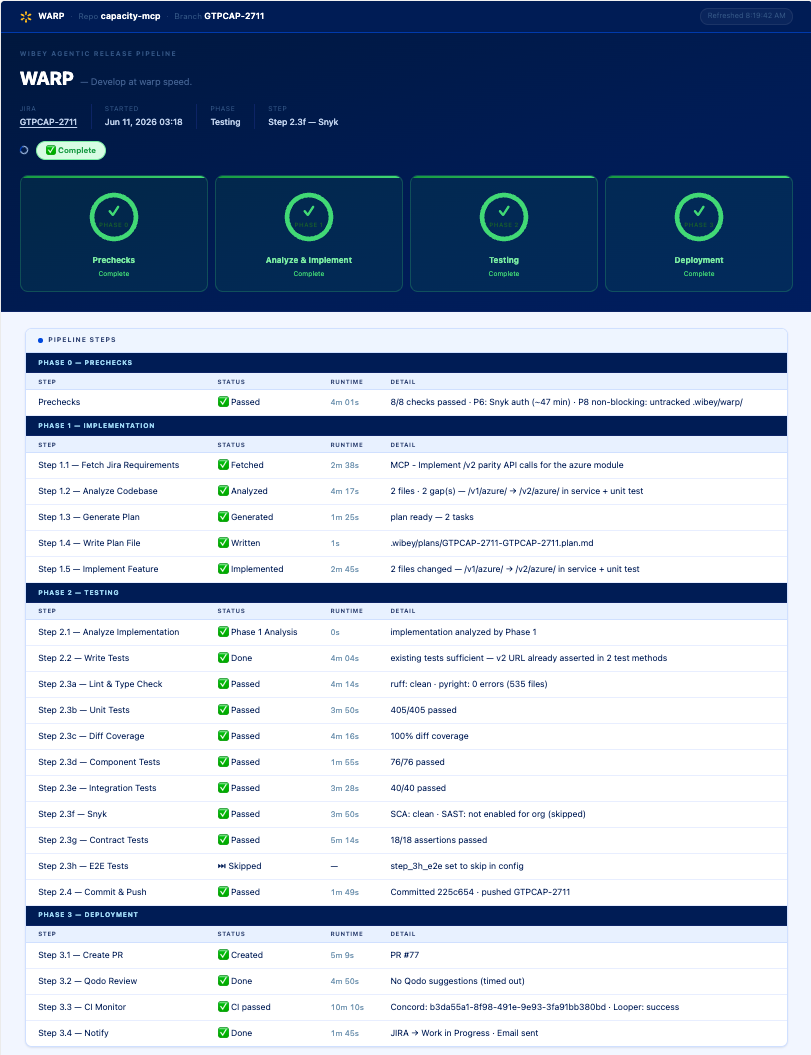
Real-time progress is surfaced via HTML work logs (auto-refreshing, with phase/step timing)
and Slack DM notifications. A persistent JIRA comment tracks full pipeline status through
every phase transition.